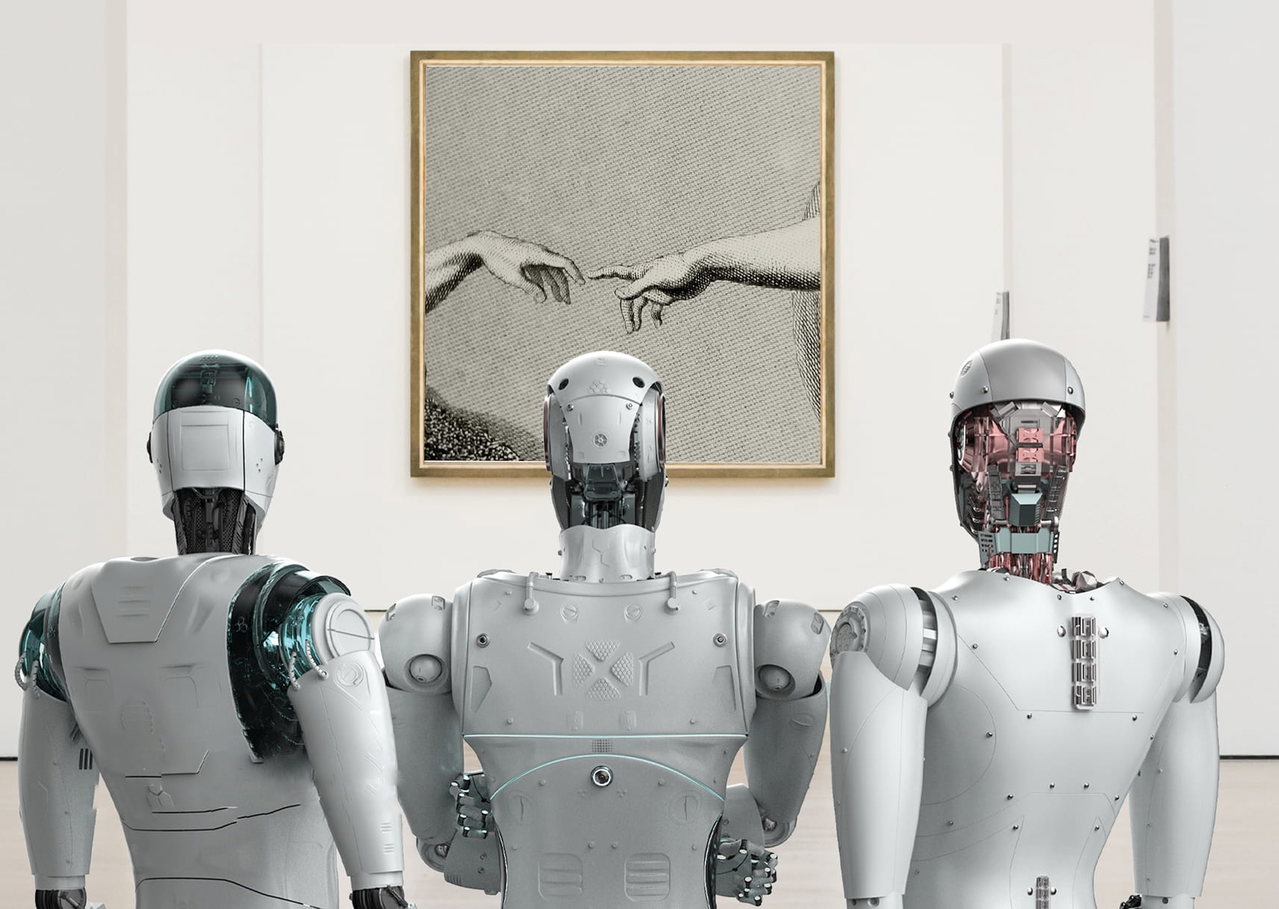
The Automated Mind: How AI is Catching Up with the ‘Functional Human’
Why Gunter Dueck’s new work, *The New Crown of Creation*, strikes a chord in the current debate on AI
The debate on artificial intelligence is marred by a fallacy. Whilst the media and arts pages are preoccupied with the ‘hallucinations’ of algorithms or nit-picking over minor errors, a far more profound upheaval is taking place quietly in the background. In *Die neue Krone der Schöpfung* (The New Crown of Creation), mathematics professor and former IBM CTO Gunter Dueck provides a precise assessment of the current state of society.

Published: XX.X.2026 | Photo by G. Dueck: Adobe
Dueck’s thesis is as provocative as it is compelling: the real risk does not lie in AI taking on human traits – but in the fact that, through bureaucracy, a ‘tick-the-box’ culture and rigid processes, humans have long since reduced themselves to mere ‘functional beings’. Anyone who merely carries out work rigidly by the book instead of acting creatively renders themselves dispensable in the face of AI.
Armed with his usual rhetorical sharpness, personal anecdotes and in-depth industry knowledge (ranging from active AI agents to the phenomenon of the ‘AI Effect’ and the global technology race), Dueck looks beyond the hype. An indispensable contribution to the debate for executives, thought leaders and readers seeking guidance beyond scaremongering and naivety.

Gunter Dueck: The New Crown of Creation. How humanoid robots are redefining our working world, society and identity. Hardback, 240 pages, September 2026. ISBN: 978-3-69046-025-5
‘Do I need to enter anything?’ – ‘No. The screen’s smashed.’ – ‘Hold on, my programme’s currently searching for “smashed”. Just a moment … Just a moment! Nothing. In that case, I’ll need to put you through to second-level support – they’re the experts. I’m afraid I’ll have to dampen your hopes, though – normally the software always finds the solution. It keeps ruling things out until we’ve pinpointed the error. That’s all the experts can do either. Why should they do more? We’re very happy with the software. Basically, I’m only here for people like you who want to speak to a human being. You could just speak your query into a computer. That would be easier.” – “Are you a human, then?” – “Yes. Why? I’m worried about my job, though. We’re about to get an AI. It doesn’t ramble on as much as I do, says my call centre trainer, who always trains me when I have to answer enquiries about other products.”
Through computerised solutions, we are reducing people to mere executors and automating their jobs to such an extent that they are effectively becoming functional beings, naturally converging towards the capabilities of humanoids. Many jobs consist of carrying out process steps, meaning that humanoids could step in immediately and would probably already be better at them than humans. Through all manner of procedures, regulations, methods, conditions, bureaucracy and standard requirements, we have already largely programmed ourselves. We have become a nation of robots. I’ll expand on this further in the next chapter. But for now, just a brief comment. Yes, everything is still in its early stages. Yes, things may move faster or stall. But you can already see the end from the beginning.
The AI Effect and a preview in quotes
Technology is constantly striving to invent and produce ever more intelligent things. People judge this by what is known as the ‘AI Effect’, as first described by the author and journalist Pamela Mac-Corduck in the late 1970s: when people find something intelligent, they admire it. But if a computer can do the same, it’s just a computer and not ‘real’ intelligence. Today, large language models (LLMs) can even speak. Yet we say: they’re just strings of probable words; these LLMs have no feelings. Soon they will have feelings. Immediately, people will say: ‘They aren’t real feelings.’ So what we admire or consider ‘intelligent’ is a moving target. It shifts further away with every advance. Once a milestone is reached, what we previously admired is no longer magical.
So are humanoids just machines after all? But the ever-shifting pinnacle of what we admire in ourselves is losing its height before our very eyes. Our reaction is: ‘That’ll never work; it’s completely impossible’. In the previous section, I wanted to make an early impression on you with self-driving cars and ‘dark factories’, which will be the precursors to humanoids. To which you reply: ‘That’s something completely different.’ It’s also fashionable, as mentioned, to say: ‘They don’t make a profit.’ Many at Amazon, Zalando, Google and Tesla have clung to this reassuring observation for several years. That doesn’t help; it does more harm than good.
Nowadays, it is more important than ever to understand upcoming developments as early as possible. When it comes to that, you will indeed see it happening right before your eyes. But by that point, we will in fact already have been overtaken by commercial enterprises that looked ahead when there were initially nothing but building sites. Innovators are familiar with a harsh saying:
‘Never show a fool work that’s not finished.’
What this means is: ‘You can only explain something to people once you can show it to them in its finished form. You have to be able to demonstrate it just like that sensational new garlic press that a travelling salesman is promoting outside the town hall. To do that, you have to shout it out loud, just like at the Hamburg fish market. Let them touch and try your product, and they’ll buy it in droves. Not before. Think of the home visits from Vorwerk vacuum cleaner sales reps, Tupperware parties and Thermomix demonstrations.’
I reckon I can ask you to read a book about something that isn’t quite finished yet. After all, my readers aren’t the sort who just shake their heads all the time. They are open to a future that will unfold as it may, even if there are many aspects of it that their hearts don’t like.
Extract from the chapter ‘How AI features in our lives’
Ask questions instead of Googling – chatbots are better
Anyone who still uses Google these days also gets instant answers from Gemini AI. They’re so much better! Who actually clicks on websites anymore?
Do you remember the days when we couldn’t use Google? Before 1997, people used Altavista; then Google came along – and the search engine that had previously dominated the market slowly declined until it finally disappeared in 2013. Google’s key feature was context-sensitive advertising, which even back then annoyed us in the form of flashing banners and remains the company’s core business to this day. Google knows better than anyone else in the world which adverts resonate best with which individuals. That’s why it can charge more for displaying adverts. Of course, there are other search engines, but they don’t have as much knowledge about their users and cannot charge as much for advertising. I’m harping on about this point because I want to make it clear to you that AI is once again transforming the business of searching for information.
The smartphone brought about the first change: whilst search engines on PCs could easily place advertising banners to the right of or above the content, on smartphones it was first necessary to find space for them. Subsequently, it became necessary to display content differently on PCs and smartphones. And now AI is here. You don’t even need to Google anything anymore!
I’m currently preparing a speech for a respiratory medicine conference. I don’t usually have much to do with lung specialists in my day-to-day life. And for my planned speech, I’m wondering: what drives these specialists? I ask ChatGPT to describe a typical working day for a respiratory specialist. I’d like to find out about typical patients and their conditions, and learn about the diagnostic technologies used. ChatGPT responds with several pages of information about patients, most of whom have chronic conditions and require regular adjustment of their medication. I feel incredibly well-informed. I ask follow-up questions such as ‘How much do the devices cost?’ and feel well-prepared. Couldn’t talk show guests or politicians be briefed in this way too? What I mean is: I no longer have to spend hours Googling and laboriously extracting information from numerous medical websites that aren’t even designed to answer my questions online. Google would have bombarded me with advert after advert. Worse still: the websites where I’d have laboriously searched for information usually veer from a factual tone to crass marketing. ‘Now that we’ve familiarised you with this condition, we’d like to advise you to order Giga-Sana straight away – you can still get it at a discount, plus a free engraved toothbrush, for just five more minutes. Even cheaper for the elderly. Hurry, your time’s running out!’
Seriously: try for a moment to get to grips with the day-to-day work of a pulmonologist without AI, and compare the effort, the time involved and the quality of the result. AI is unrivalled. Anyone who does a traditional Google search these days will see an answer from Google’s AI, Gemini, before the ‘normal’ search results. The up and down of it is that we hardly ever keep searching any further. The answer is right there. We hardly need creative search terms anymore; we simply ask questions! Today, there are many alternatives to ChatGPT and Gemini – standalone AI models such as Claude, Meta AI, DeepSeek, Xiaomi MiMo and Grok, as well as AI-powered search engines like Perplexity. For generating images, there are dedicated AI tools such as Midjourney. Just give them all a go!
These large-scale models can even write entire texts. Non-fiction books and pulp fiction are already appearing that are 100 per cent AI-generated. Software developers use AI to write programmes, whilst journalists have their articles generated from bullet points. You can create videos, summarise texts or complete school assignments. Why should the media pay for image copyright? The AI simply generates new ones. AI is making its way into every nook and cranny of our lives. A personal example: for one of my most recent books, I was determined to quote an entire page from Søren Kierkegaard’s diaries. These were published in Danish around 1855, but not in German until around 1910. The translator of the 1910 text lived for a very long time and, at the time of my project, had not been dead for even 70 years. So I had to clarify the copyright situation. That is what the law requires. How do you clarify the copyright status of a book from 1910 that may not even exist in physical form any more? Quotes were circulating on the internet – without any clarification. My publisher told me I wasn’t allowed to use them. Today, a few years later, I showed ChatGPT the Danish text from 1855 and asked for a translation. I went through it briefly, changed a word or two, and that was that.
Translating, programming, writing – all of this has now become much easier. Hardly anyone does the research for compiling material themselves any more. And this raises the question: what will become of the powerful search engines such as Google and Bing if we no longer browse in the traditional way and are forced to navigate a gauntlet of adverts? What will happen to the many website operators who currently still make a living by attracting Google searchers with fairly good non-fiction content? How will they still manage to sell Giga-Sana, self-adjusting support stockings or urea smoothie shots without relying on AI? The change in our browsing behaviour heralds a revolution in information search and dissemination. Many professions now have the opportunity to work far more efficiently. As a result, many people who aren’t particularly good at their jobs are losing them … And now we’re also seeing the arrival of AI agents that don’t just help, but take action themselves.
AI agents are already amongst us
Today, the market for AI agents – that is, AI systems capable of carrying out tasks and managing processes autonomously – is booming. They act in a goal-oriented manner and are specifically trained to do so.
AI models think and provide advice; AI agents take action.
Let’s look at a few examples.
Customer Service & Call Centre: You ring your bank to make a bank transfer. You can do this online or at an ATM in the bank lobby. You really don’t need a human for a standard transaction like that anymore. The same applies to renewing mobile phone contracts or buying train tickets. Anything that can already be done as standard via apps or on the web can be handled by AI agents. Those phrases we hate so much – ‘If you have private health insurance, press 1’ or ‘If you don’t understand German, press 2’ – can be done away with. We ring a call centre and are served very politely by a human-sounding robot adviser. “Are you sure you want this plan? You don’t actually need that much data. I can see that from your usage history here. I’d recommend the plan for 19.99 euros.” – “Why are you recommending a tariff that earns you less?” – “We’re legally obliged to inform you of the tariff that’s best value for you.” – “Ah, so you’re a robot, not a human?” – “Humans have to follow the law too, but I’m programmed this way. I can’t help but follow the law. If it came out that my programmer allowed exceptions for robo-advisers, our company would be shut down. That’s why robo-advisers are more trustworthy – though I don’t mean to say anything about humans. Would you like that tariff?” – “Yes, please.” – “I’m drawing up the contract now. Done. You’ll receive an email. Let me check your details. Everything’s already on file. Is there anything else you need?”
The virtual robo-advisor handles the entire process. It doesn’t just chat. It is fully pre-trained in the rules of the respective company. It therefore does not think or act according to the thought patterns of general AI models, but is trained as an AI agent for a specific purpose and application. I could, on the other hand, ask ChatGPT whether I should switch internet providers because it only costs 14.99 euros elsewhere. An AI agent working for an internet provider would probably play down such a query. That’s how it’s programmed.
AI agents, as in the example above, are used by insurance companies, banks, telephone companies, ticket providers, energy suppliers and credit card services. They are much more user-friendly for customers than those dull automated voice options. ‘In order for us to actually block your credit card, we need to carry out a series of tedious …’ In my example, I also wanted to convey the sense that many people who have got used to AI agents no longer want to go back to dealing with humans. Customers surveyed find that bots are more patient and more trustworthy.
Medical support: There are now many symptom checkers available online and as apps. You upload a photo of your large mole to the internet and ask whether it looks like skin cancer. Of course, you only receive an opinion, not a medical diagnosis. Your health insurance will therefore not cover the costs (as no doctor is involved). However, there are also schemes where you call an AI agent (a helpline) and describe your symptoms in detail. The AI agent then assesses which specialist you should be referred to. It then puts you through to a specialist whom it believes can resolve the problem. Alternatively, you may be offered a call-back shortly afterwards. As a result, a tele-specialist – who has already been briefed by the AI – will contact you and be able to provide advice, a diagnosis and a prescription much more quickly than they could without the AI. If the entire system is even approved by your health insurance provider, they can cover the costs. A new AI agent working behind the scenes for the specialist could handle the administrative side of this. Incidentally, the AI – or rather, an agent – currently speaks around 100 languages – so there’s no more trouble with communication between doctor and patient.
When accidents occur in hospital, surgeons groan: ‘All this bureaucracy is stopping us from getting on with our work!’ In the event of an accident, a report must be drawn up for the insurance company, and possibly another one for the police. Follow-up appointments need to be arranged. In the event of accidents, the injured person often does not live in the local area. Can you imagine how useful an AI would be – or indeed already is – that listens in on the initial consultations, presents the reports to all the necessary organisations for the doctor to sign off on, and plans and arranges all follow-up measures?
Software development: AI agents are actually already capable of writing their own programmes or testing newly developed code. In the past, a tester had to laboriously try out all standard scenarios with the new software and get creative with all sorts of invalid inputs, which often led to the system crashing. AI agents can be deployed to hack systems or attempt to gain access to passwords. AI agents could appear in video calls posing as fake senior managers and issue strange commands (‘deepfakes’). We need to give these issues even more thought. There may also be hostile AI agents.
AI, however, can even shake up entire industries – without any scandal or attack. Take this example: in February 2026, IBM’s share price fell by 13 per cent in a single day – an unprecedented event. Just like that? Everyone rubbed their eyes in disbelief. The background: the company Anthropic had announced that its new AI model, called ‘Claude Code’, had mastered the ancient programming language COBOL, which hardly any modern developer knows how to use anymore. The market immediately realised what this meant.
Back then, I had to learn FORTRAN, ALGOL and COBOL, but after fifty years I’ve forgotten it all. COBOL has been around since about 1950, and almost all ATM transactions in the US are still processed using this language today. Banks, insurance companies and public authorities find it very difficult to modernise their ancient ‘legacy code’. They are therefore forced to keep buying new IBM mainframes so that the ancient software can continue to run. What if AI could simply ‘recode’ the old COBOL code automatically?
Industry & Logistics: AI agents handle production planning, stock optimisation, route planning and demand forecasting. In the retail sector, stock levels are monitored and reorders triggered. This involves problems that are, in some cases, highly complex. Here’s an example: around 1995, in my optimisation department at IBM, we had a specific idea to optimise car sequencing. We presented our idea to various car manufacturers, who were initially interested but then turned it down. Today, no ‘grand master’ of car sequencing takes offence any more when AI agents can do it better.
This involves the final assembly of pre-fabricated and painted car bodies on the production line. This is where the interior is fitted out, the electrical systems and the cockpit are installed, and the optional extras are fitted and installed. Think of leather seats, rosewood trim, wing mirrors in special colours, heated steering wheels, and so on. The challenge is to manage thousands or even millions of different optional extras. To this end, the car bodies are transported in several rows to the start of the assembly line. Imagine a 20-lane motorway along which the car bodies arrive. The task of an AI agent is to decide which of the 20 cars at the front will be placed on the assembly line next. The cars must not, in fact, be produced in just any order. For example, no more than every second or third car should have a special feature. This allows more time for the process. So: cars with four-wheel drive, a tow bar or a panoramic roof must not be produced one after the other! As you can see, this is going to be incredibly difficult.
In the old days, there were brilliant masters with admirable intuition. They would stand at the front of the ‘sequencing buffer’ (the ready buffer) and point to unfinished cars: ‘This one first, then that one.’ And then ‘academic know-it-alls’ like us came along and wanted to let a computer decide. People didn’t believe us and rightly pointed out that, to do that, we’d actually have to integrate the various mainframe systems. There was a lack of digital end-to-end connectivity. A superbrain would have had to know the status of all customer orders, be aware of the situation in the paint shop, and have a transparent overview of the logistics chain – all in real time and just in time. That simply wasn’t possible back then.
Nowadays, everything is integrated, data is available in real time, and, in addition to the optimisation methods we used to offer, there is also AI and machine learning. Car manufacturers often offer special models that are sold ready-made with few options. This makes the immensely difficult task of car sequencing a great deal easier. Think not only of the assembly line, but also of the convoys of lorries that transport exactly the used
Furnishings should be delivered to the right place at the right time.
Openclaw is the magic word of the moment. (Please take a good look at the dates so you can see just how quickly you can become a multi-multi-millionaire.)
The development of AI agents for personal use is skyrocketing. The Austrian software developer and entrepreneur Peter Steinberger stepped down from the day-to-day management of his company PSPDFKit (now Nutrient), which had already grown considerably after ten years. He sold a significant portion of his shares to an investor and has been living as a man of independent means since 2021.
In early 2025, his interest in emerging AI was piqued, and he began to explore the new possibilities. According to the story, one Friday evening in November 2025, he developed an AI agent ‘in an hour’ with the help of Claude. Unlike in earlier attempts, this agent was not controlled via the programmer’s command-line interface, which tends to put ordinary people off. He controlled the agent via WhatsApp. This was a novelty, as AI agents themselves had existed before (AutoGPT, BabyAGI). As early as 1 January 2026, Steinberger published his development freely as open source on GitHub under the name Openclaw (there was a brief dispute over other names because ‘Claw’ sounds too much like ‘Claude’; for a short while, the agent was also called Moltbot).
Then events came thick and fast. On 28 January, entrepreneur Matt Schlicht launched a hobby project online – called Moltbook. Imagine it as a sort of Facebook, but with only AI agents as users. The ‘crazy idea’ was: Those interested would create an AI agent on OpenClaw and add it as a participant on Moltbook. They would give their AI agent a task, such as ‘Sell Bitcoins to the other bots’ or ‘Find out what makes a good bot’. On the website moltbook.com You could see the bots’ posts – in other words, watch them chatting to each other. It was so funny that the project literally went through the roof in a matter of hours and days. Within a few days, there were over a million bots swarming all over Moltbook!
Peter Steinberger became famous overnight. His OpenClaw agents went viral. Everyone wanted to give it a go. The word was: “These agents work!” For example, a bot like this could pay bills. It worked straight away, but unfortunately some agents were configured incorrectly and, for instance, revealed account numbers online.
Outrage! Hype! Moltbook and OpenClaw received a massive media response in early February 2026 (“Claw Lobster”, as in the German word for lobster). On 16 February, Steinberger wrote online that he would be moving from OpenClaw to OpenAI to make it easily accessible to everyone. In his own words: “When I started exploring AI, my goal was to have fun and inspire people. And here we are, the lobster is taking over the world. My next mission is to build an agent that even my mum can use.” [My mission now is to build an agent that even my mum can use.]
On 10 March, it was announced that Moltbook had been acquired by the Meta Group (Facebook).
Can you see just how fast AI is developing? Good ideas are snapped up by large corporations within a matter of days. When I’m writing a book like this, I hardly get a moment’s rest. There’s always something new!
Multi-agent systems: OpenClaw promises to make it a little easier to integrate AI into our lives. That is why such new approaches are immediately adopted by large companies. Let me give an example to illustrate this. Thanks to AI, a journalist no longer has to do as much work themselves. They acquire various AI agents:
• The Orchestrator or Planner is given a topic for an article by the journalist: he draws up a rough outline and plans and coordinates the further activities of the other special agents.
• The Researcher searches for information on the topic using a web browser and gathers sources and facts.
• The Writer-Agent summarises the researcher’s facts and sources into a lively and, as far as possible, interesting text.
• The Critic- or Reviewer Agent or Examiner compares the text with the facts and sources, and looks for inconsistencies and possible contradictions. Any objections are immediately forwarded to the writer’s agent.
• The Formatting Agent converts the output from the pre-press stages into the target formats for publication.
Couldn’t one agent handle all of this? No, it’s better to assign the tasks to different ‘characters’. The writer should concentrate on producing great prose; they shouldn’t be searching for facts at the same time and getting distracted. The proofreader then becomes as unforgiving as a strict teacher. Specialisation yields better results. ‘It’s best if the writer doesn’t proofread their own work.’ The agents also use various tools for their work.
Virtual humanoid AI agents
Why do chatbots only speak to us like cartoon avatars? Why doesn’t a real person – or rather, an artificially real person – appear? ChatGPT has been able to speak for some time now. I don’t have to chat in writing; it works perfectly well verbally. But why doesn’t ChatGPT show a face to go with it? Surely one could imagine a few fictional characters to choose from. Then I could chat with an artificial Lady Gaga or an artificial Dieter Bohlen – well, a T-Rex or something like that would do too – please use your own imagination.
Technically, it’s not quite that simple yet. When I speak to an avatar – that is, an artificial character – my speech has to be recognised first. Of course, I am recognised, but it takes processing time. After that, the AI considers a response and then generates a suitable facial expression to match the reply it is about to give. When I speak to a real person, their face reacts within less than 300 milliseconds (‘latency’). If it takes any longer, a person perceives their counterpart as ‘synthetic’ or simply strange.

Prof. Dr Gunter Dueck is an entrepreneur, mathematician and computer scientist. As one of Germany’s leading futurists and the author of numerous books, including, amongst others, Swarm stupidity and The New and Its Enemies, Dueck explores the impact of digitalisation and AI. The former Chief Technology Officer at IBM Germany is now also regarded as a sought-after speaker, presenter and consultant.