Community as infrastructure for local media
Highlights from the Medienhaus-NEXT Conference | MedienNetzwerk Bayern
Local newspapers, broadcasters and online portals need to focus less on reach and more on building relationships. Recent examples demonstrate precisely this. Local media organisations that view the community merely as a comments section or as a by-product of social media are underestimating its value. This is because effective community engagement can not only enhance discussions, but also boost usage, registration rates and even willingness to pay.
Published: 21 May 2026 | Photo / Video: Magnific
“Reach is borrowed attention; relationships are your own capital”: That was how he promoted Kevin Kallenbach, CEO of the tech services provider ferret go, recently at the Media House NEXT-Conference in Munich called on local media organisations to adopt a new way of thinking. They should stop viewing the community as a nice little extra; it is now infrastructure, according to Kallenbach, who has spent many years working in various roles at local publishing houses.
The figures prove him right. The Data availability is, if interpreted correctly, encouraging for local media: The Reuters Institute Digital News Report 2025 involving nearly 100,000 respondents from 48 countries, including a German sub-study of the Leibniz Institute for Media Research, Hamburg shows:
If the German online population still trusts the news in the age of social media and AI (45 per cent do), it is most likely to trust public service broadcasters and local and regional newspapers.
To be even more specific: according to a Reuters report, regional and local daily newspapers have a trust rating of 63 per cent – just behind the ARD Tagesschau (65 per cent), but well ahead of the national tabloid press.
At the same time, the Challenge: 71 per cent of German internet users avoid News is active at least occasionally. And for the youngest, social media and creators are as the main source of news has become. For an ever-increasing number of people, a traditional newsroom is therefore effectively invisible.
Good moderation elicits a response
This is exactly where community management comes in – as one of the possible responses to news avoidance, a lack of trust and dwindling visibility. A market study carried out in 2024 by ferret go and the market research institute BTG on behalf of the dfv Mediengruppe provides specific figures on this:
According to the survey, 71 per cent of respondents would use a website with a good comments section more often than they have done so far.
65 per cent find that constructive dialogue helps them to form their own opinions.
42 per cent of those who comment rarely or not at all say they would participate more often if the quality of the discussion were better.
A conclusion from the analysis:
What puts users off the most?
Unobjective or discriminatory comments (39 per cent), followed by technical barriers such as compulsory registration and a lack of clarity. Effective moderation is therefore essential.
In addition, the research project “Hello, dear community!" by Prof. Dr Marc Ziegele and Dominique Heinbach from the Heinrich Heine University Düsseldorf, funded by the State Media Authority of North Rhine-Westphalia: Encouraging moderation has been shown to improve the quality of discussions and the perception of media brands. Active and respectful moderation of online communities makes all the difference.
Rebranding ...
For Cordula Schmitz, Digital Editor-in-Chief at the *Hamburger Abendblatt*, the fundamental nature of the relationship between local media professionals and their audience has changed. She wants to consign the old ‘sender and receiver’ model to history. Schmitz at the NEXT conference: “Today, we are more ‘receivers’ and still need to learn how to deal with that.”
It’s no easy task – such a fundamental paradigm shift for newsrooms that have been ‘on air’ for decades. Schmitz and her team are therefore trialling the format of an open editorial meeting: journalists go out, talk to people and show the regions the face of the newspaper. The organisation is reversing the situation where “journalists were condemned to their desks”.
Making money isn’t really the main focus at this early stage. The *Hamburger Abendblatt* wants to to firmly establish the brand in the local community, to recharge and revitalise them.
noz: LOKALpuls – Readers as research partners
In a small market with a population of around 60,000, *noz* is taking the *LOKALpuls* project a step further: users ask questions on topics that the editorial team has not yet addressed. The editorial team then sets to work, carries out research and provides answers.
For the most part, AI cannot answer these questions. Research is needed.
noz: ask noz – the archive as a dialogue interface
With “frag noz”, the editorial team has introduced an AI-powered question-and-answer feature based exclusively on its own archive of articles. “We’ve discovered that we can unlock the treasure trove of our archive using AI,” said Editor-in-Chief Riepe. The Osnabrück-based publication sees peaks in usage during local events such as snow chaos.
The project can largely rule out AI-generated hallucinations, which are viewed with scepticism, because no external data is fed into the system. At *noz*, community engagement and archival value go hand in hand.
SZ: Wordle and the puzzle community – a ritual as a means of fostering connection
The Süddeutsche Zeitung’s initiative shows that a community does not always have to be about debate. Here comes Gamification game elements or mechanics that can captivate people. With nine regular features now – including Wordle in German and Sudoku – the SZ Puzzle World has built up a stable, growing community. These include chats in the SZ app and a newsletter.
The lesson learnt by the editorial team: “Puzzles are a good way of introducing new people to the SZ brand, not just of retaining existing readers.”

In his analysis of the situation facing local newspaper publishers, Kallenbach, the manager of ferret-go, issued an important warning: “Publishers are losing direct access to users, as most engagement takes place via other platforms.”
This is also confirmed by the Figures:
For around a third of 18- to 24-year-olds, social media is the most important source of news. As far as they are concerned, traditional news websites are effectively non-existent.
And whilst YouTube, WhatsApp and Facebook are the most widely used news channels on social media amongst the online population as a whole, amongst younger people it is Instagram (29 per cent), YouTube (23 per cent), WhatsApp (20 per cent) and – with strong growth – TikTok – platforms on which publishers have, by their very nature, little control over their relationship with their readers.
Insta, TikTok and the like are not the enemy, but neither are they the end goal. One conclusion drawn at Medienhaus NEXT was: “Social media today is not just about distribution, but about showcasing relationships. It’s the starting point, but not the actual goal.” Those who cultivate relationships solely on third-party platforms are building on borrowed ground.
For Kevin Kallenbach, it is not clicks that are the new measure of success for local businesses, but the relationship score: “Whoever controls the relationship controls the business.” This requires dedicated community spaces, user profiles based on data, moderated debates, dialogue formats and the courage to view interaction as part of the product, not merely as a side effect.
This overview of the ferret-go study summarises its key findings (Download) together:
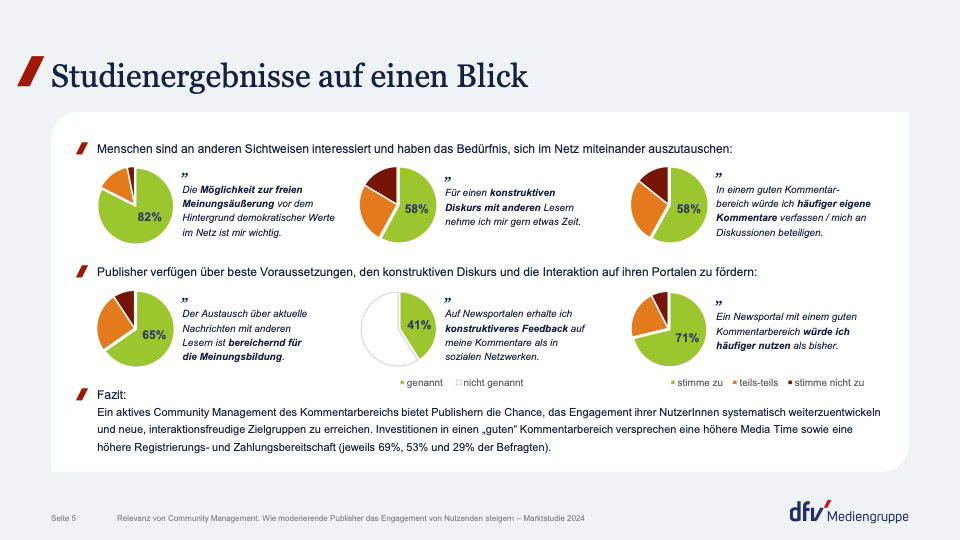
Great potential in local journalism
Effective community formats have one thing in common: they treat interaction not as a means to an end, but as a value in itself. Various studies point clearly in one direction: trust exists, and is even higher than average in the case of local media. The question is whether we can succeed in translating this trust into genuine relationships before it continues to dwindle due to news avoidance and platform dependency.
Klaus Meier’s question remains open and thought-provoking: Can personal encounters be turned into a business model? Inviting people into old printing works on a regular basis, putting the newspaper on stage? Editorial work based on dialogue builds trust. “This can be successful; what’s important is a new way of thinking,” says the media scholar from Eichstätt, who is also campaigning for greater collaboration between media organisations in local journalism.
For local media, this means that community should be the answer to a world in which AI produces ever more content, but no relationships.
For branding experts Katerina Hinrichs Community is ‘the new currency’ on the internet. On LinkedIn She writes: “A community is far more than just a list of followers. It is a group of people who share your values, value your expertise and – this is the crucial point – trust you.”
The value and importance of local media – including local radio, TV and newspapers – are at the heart of the newly formed LOCAL MEDIA DAYS on 24 and 25 June 2026 at the NCC Mitte at NürnbergMesse. A range of examples of successful community management will be presented. Tickets are available here.

Petra Schwegler works in communications and marketing for Medientage München. Previously, the qualified journalist was in charge of the news desk at the trade journal W&V. Photo: Media.Bavaria GmbH, Alexander von Spreti
to the Original text (Media Network Bavaria)
The Media Network Bavaria, is an initiative for Bavaria as a media hub. Through its events and projects, it brings together the Bavarian media industry to address the trends and challenges of digital transformation. It fosters networking not only within individual media segments (such as audio, film or the press) but also across sectoral boundaries (for example, with the automotive industry, the medical sector or the scientific community). MedienNetzwerk Bayern is part of the Media.Bavaria GmbH.