Twipe Insights: Getting more done together
3 resources on overcoming misalignment
A lack of alignment between different groups is now the second most frequently cited barrier to innovation, according to the latest trends and predictions report by the Reuters Institute for the Study of Journalism.
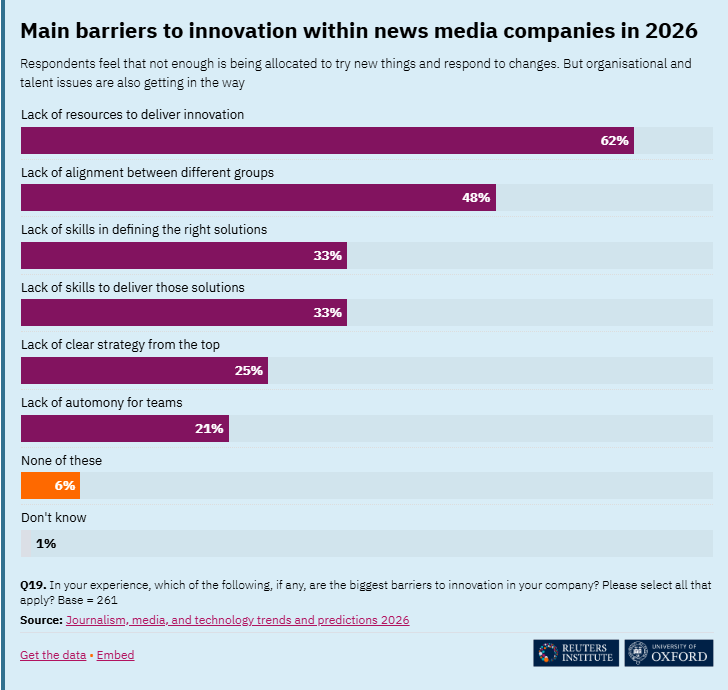
That finding will come as no surprise to anyone working within a media organisation. Great ideas stall not because they are bad, but because teams are pulling in different directions or decision-making is fragmented.
With that in mind, this week’s edition brings together three resources that examine alignment from different angless: from general team dynamics, to media-specific stakeholder management, to specific case studies from within newsrooms. Together, they offer practical ways to reduce friction and get more done together this year.
1. The Five Dysfunctions of a Team: a classic, and for good reason
Let’s get this out of the way: The Five Dysfunctions of a Team It’s a bit cheesy in the way that only business books can be. But the upside is that it’s a quick read (you can get through it in an afternoon & Here’s a recap) and it’s packed with insights that still hold true today.
The book explores five key dysfunctions that prevent teams from working well together, through a fictionalised account of a leadership team that is struggling, but is gradually learning how to function as a genuine team. Whilst it is framed around leadership, the lessons apply just as much to individual contributors.
If you ever feel that something is ‘off’ within your team (or between teams), this framework provides you with the tools to diagnose what’s wrong: trust, conflict, commitment, accountability, or a focus on results. Even if you don’t read the whole book, understanding these dynamics can make it easier to spot where alignment is breaking down and why.
2. Working across stakeholder groups: lessons from within media organisations
To put this into a more familiar context, Selma Stern, writing for Audiencers, offers a very a practical guide to working effectively with different stakeholders within a media organisation.
Her advice is written with subscription teams in mind, but it applies much more widely. At its core, it’s about operating without full control: learning how to influence decisions when you don’t have outright ownership of them.
That means:
Using storytelling to present ideas in a way that resonates with others
Building consensus rather than pushing solutions
Being realistic about what you can and cannot change
For anyone working across different departments, this is a practical guide on how to collaborate effectively.
3. From theory to practice: Real-life newsroom case studies
Whilst the first two resources provide you with language and mental models, this final resource shows how they play out in the real world. It is not a single article, but a series of interviews and case studies by Mariah Craddick, Executive Director of Product at The Atlantic.
In these articles, she speaks to product leaders across various media organisations about how they actually collaborate with editorial, engineering and other teams to build news products together. These are real-life examples of what alignment looks like in practice, including the trade-offs, tensions and compromises involved.
Here are a few good ones from the series to get you started:

Sarah Cool-Fergus is the Marketing Lead at Twipe.